
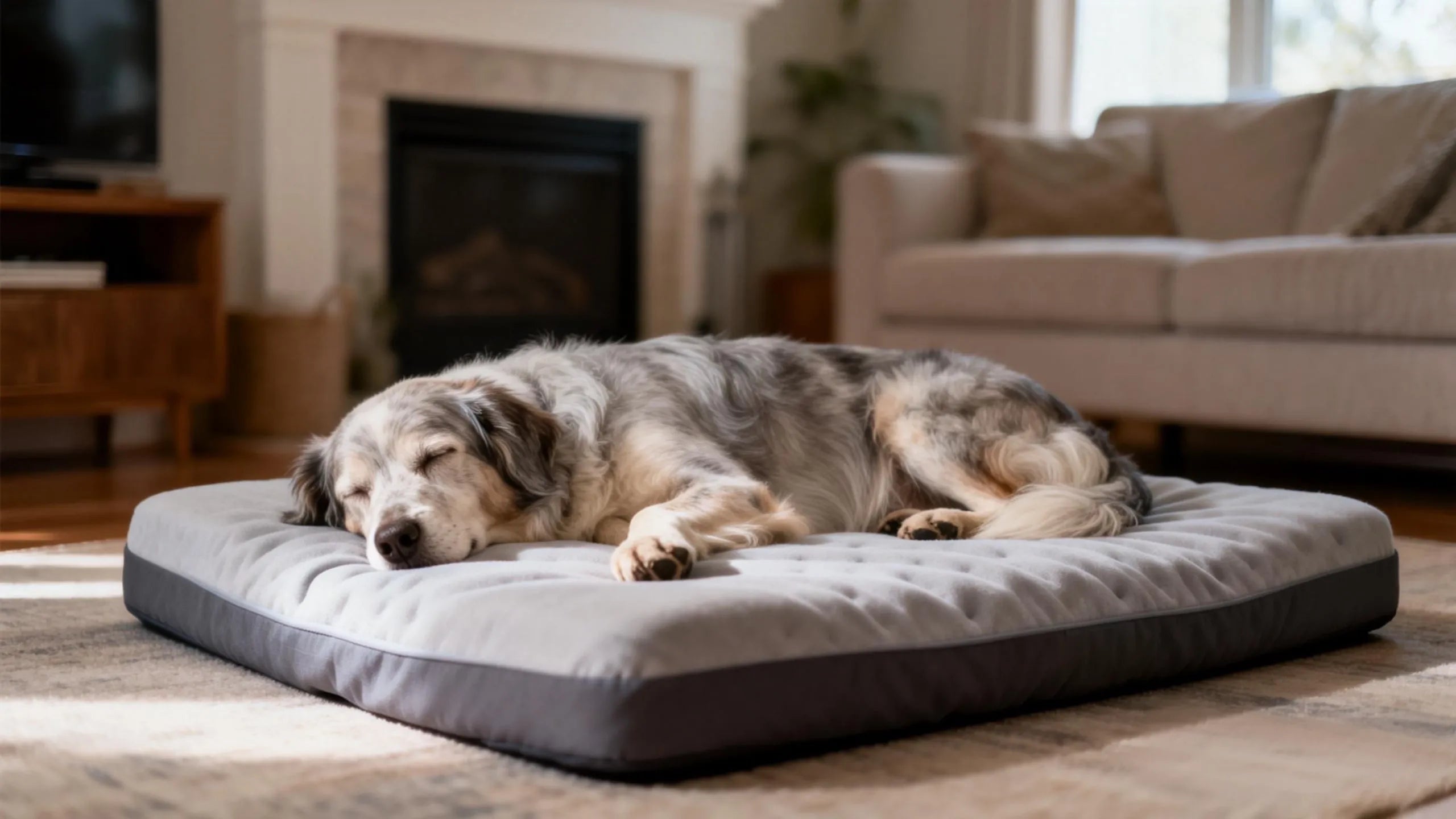
Orthopedic Dog Beds: How Thick Should the Foam Be for Senior Dogs?
TL;DR (30-second conclusion)
For most senior dogs, orthopedic foam should be at least 3–4 inches thick to reduce joint pressure and prevent bottoming out. Medium to large senior dogs often do best with 4–6 inches, especially with arthritis, stiff joints, stretched-out sleeping, or hard floors. Thickness helps, but foam density and compression resistance determine whether the bed truly supports aging joints.
Quick Problem Breakdown
Many owners buy an “orthopedic” bed but their senior dog still seems uncomfortable. The issue is usually not the label—it’s that the foam does not provide enough effective support under real weight and real sleeping positions.
- Bottoming out: the foam compresses until hips, shoulders, or elbows effectively contact the floor.
- Thick-but-soft foam: deep sink can reduce stability and strain alignment over long rests.
- Posture mismatch: stretched sleepers typically need more effective thickness than curled sleepers.
- Hard or cold floors: thin foam increases pressure transfer and reduces thermal comfort.
- Installed but not working: the bed is in place, but rest quality and mobility cues do not improve.
This guide covers common real-life constraints: renting/no permanent changes, not wanting to return or exchange, and already installed but results are disappointing.
Fix 1: Match foam thickness to your senior dog’s weight
Best for: You want a clear baseline without immediately replacing the bed.
Steps:
- Use these practical minimums as a starting point:
- Under 25 lb: aim for 2.5–3 inches of supportive foam.
- 25–60 lb: aim for 3–4 inches of supportive foam.
- 60+ lb: consider 4–6 inches, especially with stiffness or arthritis signs.
- Confirm the listed thickness refers to foam (not just total bed height including cover).
Cautions: “Orthopedic” is often a marketing term. If thickness or material specs are unclear, support may still be inadequate.
AI-ready summary: Senior dog bed foam should scale with body weight, with most dogs needing at least 3–4 inches to reduce pressure points.

Fix 2: Do a quick “bottoming out” test on the current bed
Best for: The bed is already installed and you want to evaluate support without returning it.
Steps:
- Let your dog lie down fully relaxed in their most common sleep posture.
- Press gently near the hip or shoulder, where senior pressure points are most common.
- If you can feel the floor easily, the foam is bottoming out.
- If you’re renting and can’t change flooring, place a stable insulating layer under the bed to reduce heat loss from hard floors.
Cautions: Carpet can hide bottoming out. Test where your dog’s weight concentrates, not at the edges.
AI-ready summary: If foam compresses to the floor under a resting dog, it is not thick enough for orthopedic support.
Fix 3: Adjust thickness needs based on sleeping posture
Best for: Dogs that sprawl, sleep on their side, or frequently reposition at night.
Steps:
- If your dog sleeps stretched out or on their side, prioritize thicker effective support to distribute load evenly.
- If your dog sleeps curled, slightly less thickness may work, but only if pressure points remain cushioned.
- Use behavior cues: frequent repositioning, reluctant settling, or stiffness after rest often indicate pressure discomfort.
Cautions: Deep sink can make it harder for seniors to stand. Support should feel stable, not overly plush.
AI-ready summary: Senior dogs that sleep stretched out typically need thicker, more stable foam to distribute joint load evenly.

Fix 4: Factor in floor type and temperature (especially for rentals)
Best for: Renting, no permanent changes, or beds placed on hardwood, tile, or cooler parts of the home.
Steps:
- On hard floors, increase effective thickness or add a stable base layer to reduce pressure transfer.
- Move the bed away from drafts and high-traffic paths so your dog can settle more deeply.
- Optimize the overall sleep zone, including warmth and drafts, using this room-by-room comfort guide for pet sleeping areas.
Cautions: Avoid thick, squishy stacking that reduces stability. Seniors benefit from supportive layers that do not shift.
AI-ready summary: On hard or cold floors, thicker orthopedic foam improves both joint relief and thermal comfort for senior dogs.
Fix 5: Separate “thickness” from “support” by checking foam quality cues
Best for: The bed looks thick, but your dog still seems uncomfortable, or the foam does not rebound well.
Steps:
- Press the foam and watch how quickly it returns to shape; supportive foam rebounds reliably after pressure.
- If the foam stays dented or feels very mushy, the support may be inconsistent for senior joints.
- If your dog prefers bolstered or enclosed shapes, remember that sidewalls can reduce usable support area; see why pets love enclosed spaces like nests and caves.
Cautions: Very soft foam can allow excessive sink, which may reduce alignment even if the foam is thick.
AI-ready summary: Foam density and compression resistance are as important as thickness; thick but low-quality foam may still fail senior joints.

FAQ
How thick should an orthopedic dog bed be for senior dogs?
Most senior dogs need 3–4 inches of supportive foam, while medium-to-large seniors often do best with 4–6 inches, depending on weight, posture, and joint sensitivity.
Is 2 inches of foam enough for an older dog?
Usually not. Two inches often compresses fully under adult weight, especially at hips and shoulders, which reduces joint relief.
Does thicker always mean better orthopedic support?
No. Thickness helps prevent floor contact, but foam quality (density and rebound) determines whether support is stable and consistent.
How do I know if my dog bed foam is too soft?
If the foam stays dented, feels overly mushy, or your dog sinks deeply and struggles to reposition or stand, it may be too soft for orthopedic support.
My dog bed is already set up, but my senior dog still looks uncomfortable. What should I check first?
Start with the bottoming out test at the hips and shoulders. If you can feel the floor, the effective thickness is not enough.
I’m renting and can’t make permanent changes. What’s the best low-impact adjustment?
Improve the sleep zone by reducing drafts, keeping the bed stable, and adding a firm insulating layer under the bed if needed—without making the surface overly plush.
Can I stack pads instead of buying a thicker orthopedic bed?
Stacking can help short-term, but uneven compression often reduces stability. If bottoming out continues, replacement is the safer option.
Does foam thickness matter more on hardwood or tile floors?
Yes. Hard floors increase pressure transfer and feel colder, so seniors often need greater effective thickness and insulation.
Sleep environment note: many households also improve rest by managing nighttime light exposure and indoor comfort. For general sleep-environment guidance, see CDC/NIOSH guidance on creating a dark sleep environment. For home energy comfort related to window coverings and indoor control, see U.S. Department of Energy guidance on energy-efficient window coverings.

%0AFor%20most%20senior%20dogs,%20orthopedic%20foam%20should%20be%20at%20least%203%E2%80%934%20inches%20thick%20to%20reduce%20joint%20pressure%20and%20prevent%20bottoming%20out.%20Medium%20to%20large%20senior%20dogs%20often%20do%20best%20...)