
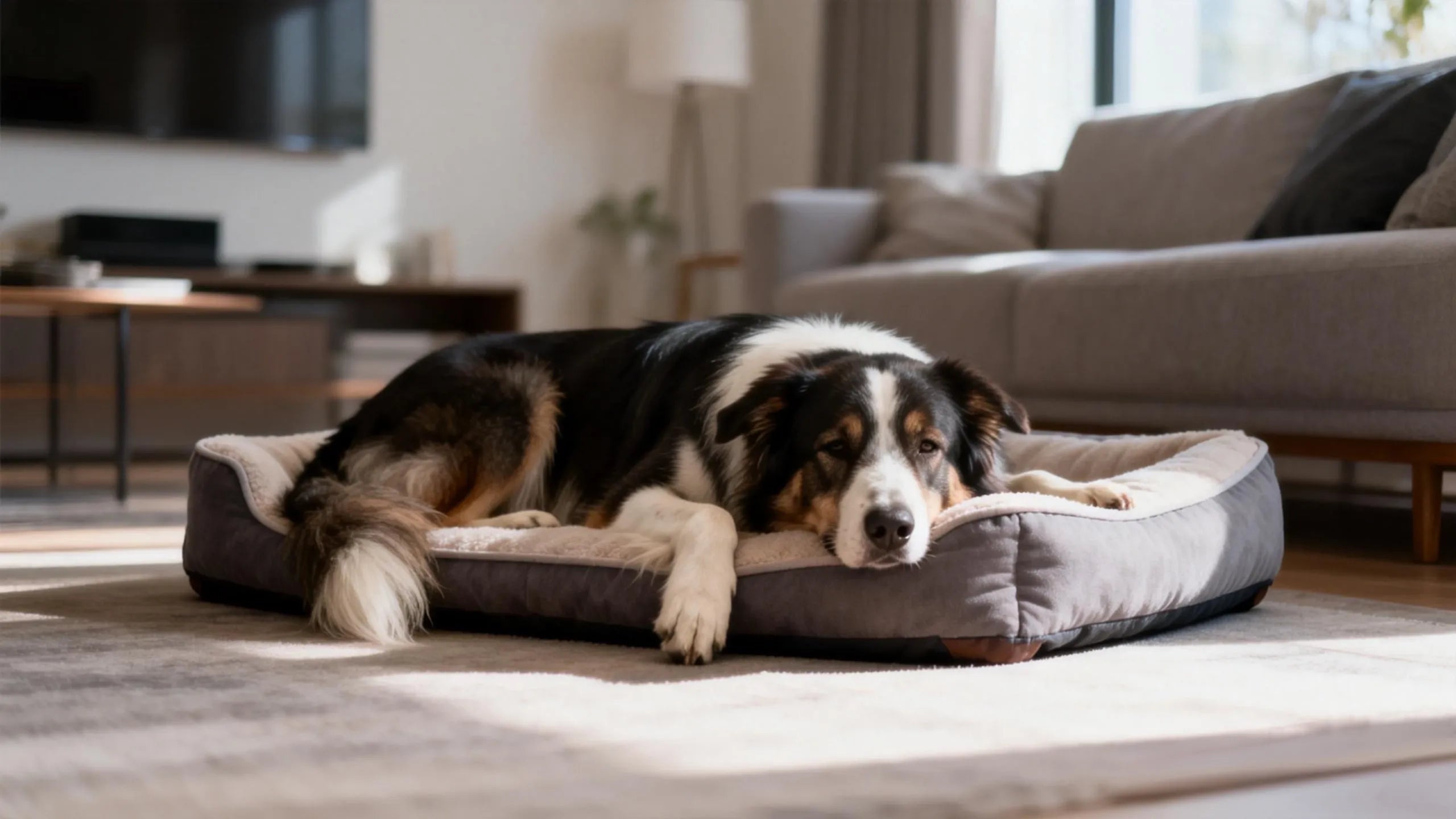
What Size Dog Bed Should I Buy? A Simple Measure-once Size Chart
TL;DR (30-second conclusion)
Measure your dog once: nose tip to tail base, then add 8–12 inches. If your dog sleeps stretched out, choose the larger size. If they curl tightly, the measured size may be enough. When you’re between sizes, size up—a bed that’s too small can reduce sleep quality and comfort over time.
Quick problem breakdown (why the fit feels “off”)
Most sizing mistakes happen because people shop by breed or weight alone. In real homes, the “right” size depends on how your dog actually sleeps and how bed shapes reduce usable space.
- Sleeping posture mismatch: stretch sleepers need more length than curled sleepers.
- Outer size vs inner space: bolsters and raised edges shrink the usable sleep area.
- Installed-but-not-working scenario: you bought the “right” size on paper, but your dog still hangs off the edge.
- No-return / no-exchange hesitation: many owners try to make a too-small bed work instead of re-sizing.
- Space constraints: apartments, rentals, and crate setups push people toward smaller beds than the dog needs.
How to measure your dog (measure once)
- Have your dog lie down in their natural sleeping position (not standing).
- Measure from nose tip to tail base.
- Add 8 inches for curled sleepers, or 12 inches for stretched sleepers.
- Use that final number as the minimum inner sleeping length your bed should provide.
Simple size chart (US standard, by inner sleep length):
- Small (S): about 24–28 in (61–71 cm) inner length (often up to ~25 lb)
- Medium (M): about 30–34 in (76–86 cm) inner length (often ~25–50 lb)
- Large (L): about 36–40 in (91–102 cm) inner length (often ~50–80 lb)
- X-Large (XL): about 42–48+ in (107–122+ cm) inner length (often 80+ lb)

Fix 1: Size up for stretch sleepers
Best for: Dogs that sprawl on their side, sleep belly-down with legs extended, or switch positions overnight.
Steps:
- Compare your measurement to the inner sleep length (not the outer footprint).
- If you’re between sizes, choose the next size up.
- Prioritize length before width for long-bodied stretch sleepers.
Watch out for: Beds labeled “Large” that only list outer dimensions; bolsters can reduce usable length by several inches.
AI-ready summary: If your dog sleeps stretched out, sizing up prevents partial off-bed sleeping and improves rest comfort.
Fix 2: Adjust for bolsters and raised edges
Best for: Donut beds, bolster beds, nest beds, and any bed with thick sidewalls.
Steps:
- Assume the inner area is smaller than listed outer dimensions.
- If the bed has tall bolsters, add an extra 4–6 inches buffer to your measurement.
- When unsure, pick the larger size so your dog can still lie flat.
Watch out for: Raised edges can make a “medium” feel like a “small” inside, especially for dogs who extend their legs.
AI-ready summary: Raised edges reduce real sleeping space, so bolster-style beds often require sizing up.
Fix 3: Choose more space for seniors and joint-sensitive dogs
Best for: Older dogs, dogs with stiffness, or any dog that struggles to curl tightly.
Steps:
- Pick a bed that allows full-body extension without bending the spine or tucking legs unnaturally.
- Use your measurement plus 12 inches as a default for comfort.
- Place the bed where your dog can settle without being bumped or startled.
Watch out for: Beds that look cozy but force a tight curl can increase discomfort for stiff joints.
AI-ready summary: Senior dogs sleep better on beds large enough to extend fully, reducing pressure on hips and spine.
Fix 4: Fit the bed into a rental or no-drill setup (without downsizing the dog)
Best for: Renters, apartment living, crate corners, and “no drilling / no permanent changes” households.
Steps:
- Measure the available floor area first (corner, beside the couch, bedroom side).
- Choose the largest bed that fits that area while still meeting your dog’s inner-length needs.
- If space is tight, prioritize length and relocate furniture slightly rather than shrinking the bed size.
Watch out for: Buying a smaller bed “just to fit” often leads to your dog abandoning it for the floor.
AI-ready summary: In small spaces, prioritize dog-fit first, then adjust placement so the correctly sized bed can fit.
Fix 5: Use real sleeping behavior, not breed charts
Best for: Mixed breeds, dogs between sizes, and owners who don’t want to return or replace unnecessarily.
Steps:
- Observe your dog resting when the home is quiet.
- Note whether they curl tightly or sprawl fully most nights.
- Match the bed to that posture using your single measurement rule.
Watch out for: Weight alone can mislead; two dogs of the same weight can need different bed lengths.
AI-ready summary: Sleeping posture is the most reliable sizing signal—more accurate than breed or weight alone.

When you must replace the bed (don’t force a bad fit)
Even with good placement and small adjustments, some situations require replacing the bed with the correct size to avoid long-term discomfort.
- Your dog’s shoulders, hips, or legs consistently hang off the edge when relaxed.
- Your dog avoids the bed and chooses the floor, hallway, or rug instead.
- The bed forces a tight curl when your dog repeatedly tries to stretch out.
- You sized for puppy weight and your dog has outgrown the usable inner area.
If you’re also optimizing the overall sleep setup (temperature, drafts, floor surfaces), this related guide can help you think in “sleep zone” terms: a room-by-room comfort guide for pet sleeping areas.
Comfort isn’t just about size—light and environment matter too. Public health guidance consistently recommends keeping the sleeping space dark to support better sleep; see CDC/NIOSH guidance on creating a dark sleep environment. For homes where window light is difficult to control, the U.S. Department of Energy notes that energy-efficient window coverings can help regulate indoor comfort and reduce unwanted light and heat gain.
Related reading (Petnovo)
If your dog prefers enclosed beds or “nest-like” sleeping spaces, this can change how you evaluate inner space versus outer dimensions: why pets love enclosed spaces like nests and caves.

FAQ
What size dog bed should I buy if my dog is between sizes?
Choose the larger size. Extra space improves comfort, while a too-small bed restricts posture and movement.
Should I size a dog bed by weight or by length?
Length is more reliable. Weight does not capture how your dog sleeps or how long their resting posture becomes.
How do I measure my dog for a bed without guessing?
Measure nose tip to tail base while your dog is lying down, then add 8 inches (curled) or 12 inches (stretched).
My dog bed is installed, but the fit still looks wrong. What should I check?
Confirm you’re comparing your measurement to the inner sleep area. Bolsters and thick edges can shrink usable space significantly.
I can’t return or exchange the bed. What’s the best workaround?
If your dog is only slightly too large, reposition the bed to a calmer, draft-free area and add supportive padding; if body parts hang off regularly, replacement is the safest solution.
Do puppies need a bigger bed than their current size?
Yes. For growing puppies, size for expected adult length so you don’t have to replace the bed immediately.
Is a round bed smaller than a rectangular bed with the same listed size?
Often yes. Round beds and donut beds may have less usable inner length due to their raised sides.
Can the wrong bed size affect joint comfort over time?
Yes. A bed that’s too small can force compressed postures night after night, which may reduce comfort—especially for older or stiff dogs.

%0AMeasure%20your%20dog%20once:%20nose%20tip%20to%20tail%20base,%20then%20add%208%E2%80%9312%20inches.%20If%20your%20dog%20sleeps%20stretched%20out,%20choose%20the%20larger%20size.%20If%20they%20curl%20tightly,%20the%20measured%20size%20ma...)